
Foundations / Research in development
The Escentron
Based on The Three Escentron Postulates, Version 2.0 — Revision alpha.7.
The Escentron is the fundamental particle proposed by the Simplification Theory. The model describes how each particle carries energy, generates fields, and responds to the fields of other particles.
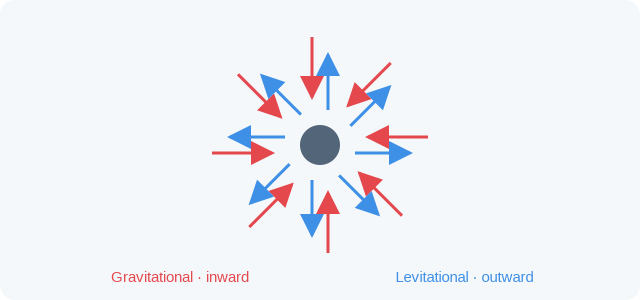
Three forms of energy
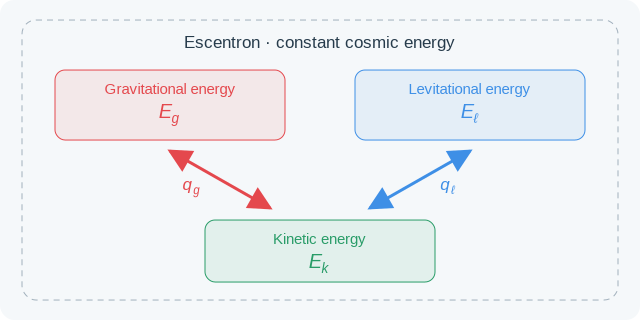
An Escentron carries energy in three forms:
- Gravitational energy — associated with its gravitational mass.
- Levitational energy — associated with a property called pulse.
- Kinetic energy — associated with its motion.
Together, they form the cosmic energy of the particle.
The amount of energy in each form can change during motion. The total cosmic energy remains constant.
Three variable properties
| Property | Symbol | Associated energy |
|---|---|---|
| Gravitational mass | ||
| Pulse | ||
| Velocity |
All three energies have the same quadratic form.
Each Escentron also has a fixed inertial mass , which determines its kinetic-energy coefficient, . Its gravitational mass, in contrast, can change as energy is converted within the particle.
Two fields
Each Escentron generates two fields.
Its gravitational mass generates an attractive gravitational field. The strength of this field decreases with the square of the distance.
Its pulse generates a repulsive levitational field. The strength of this field decreases with the cube of the distance.
At any receiving Escentron, contributions from other particles add independently for each type of field.
Balance
Each Escentron has an abstract balance parameter, defined as the ratio of its pulse to its gravitational mass.
When two Escentrons interact, their joint balance parameter is the product of their individual balance parameters. The distance at which their applied work vectors cancel follows from the field and response laws.
Read The Balance Relation for the distinction between abstract and interactive balance.
Energy conversion
The fields of other Escentrons drive energy conversion within a receiving Escentron.
Each incident field directly induces a work vector along its direction. The two applied work vectors add to change the kinetic vector of the particle. The resulting change in kinetic energy is balanced by changes in its gravitational and levitational energies.
The distribution of energy changes while the total cosmic energy remains constant.
The model and its current status
These properties describe a proposed experimental model. The physical units and the time-stepping behavior remain subject to validation.
For the complete mathematical definition, including the rules for energy allocation and numerical limits, read The Three Escentron Postulates.