
Mathematical Framework / Research in development
The Balance Relation
Based on The Three Escentron Postulates — Version 2.0, Revision alpha.7.
Abstract balance
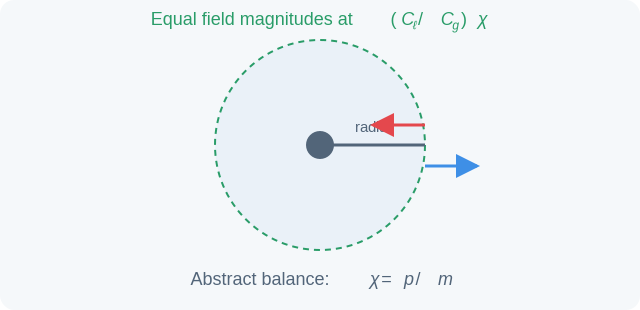
The abstract balance parameter of an Escentron is the ratio of its pulse to its gravitational mass:
This parameter describes the particle's instantaneous state, independently of any particular receiving particle. The distance at which the magnitudes of its two generated fields are equal is .
Interactive balance
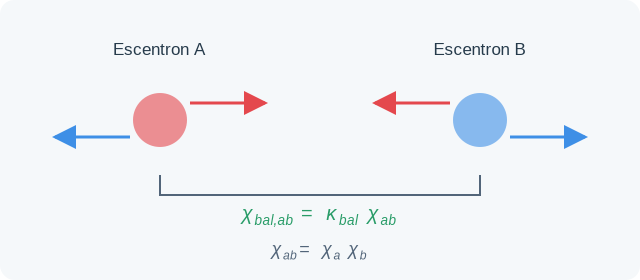
Two Escentrons have a joint balance parameter defined by the product of their individual balance parameters:
This relation is symmetric: .
Unlike abstract balance, interactive balance involves both particles. Each receiving particle responds to the incident fields according to its own gravitational mass and pulse.
Connection to the work laws
For two isolated particles with positive mass and pulse, the third postulate gives the following condition for cancellation of the receiver's unrestricted work vectors:
Solving for the separation gives
With common work and field coefficients, both particles have the same instantaneous balance distance. Define the fixed conversion coefficient :
The abstract and interactive parameters are defined independently of the choice of dimensional units. In normalized coordinates where the combined prefactor is numerically one, the numerical value of the balance distance equals . The dimensional prefactor must be retained in the general expression.
Research direction
Mutual cancellation of work in an isolated two-particle system is a starting point for investigating bound structures. Testing whether the model can reproduce stable hydrogen-like structures is a research objective. Instantaneous cancellation alone does not demonstrate atomic stability or reproduce the observed properties of hydrogen.