
Foundations / Research in development
Introduction
Nature through simplicity
Imagine starting with just one kind of particle and three fundamental principles.
How far could we go?
Could we build a model that reproduces the behavior of matter? Could we recreate the physical phenomena we observe in nature, from the smallest structures to the largest cosmic systems?
This is the adventure of the Simplification Theory.
Building nature inside a computer
We begin with a fundamental particle called the Escentron.
We define its properties, its energy, and the way it interacts with other particles through three fundamental postulates.
Then we bring it to life inside a computer.
We design experiments based on our observations of nature. Each experiment defines an expected physical behavior. We develop our mathematical model, run simulations, and compare the results with what we observe in the physical world.
Our model has to pass these tests.
Every time the model successfully reproduces a physical phenomenon, we take another step forward. Then we introduce a new experiment, a new condition, and a new challenge.
Step by step, we move from simplicity toward complexity.
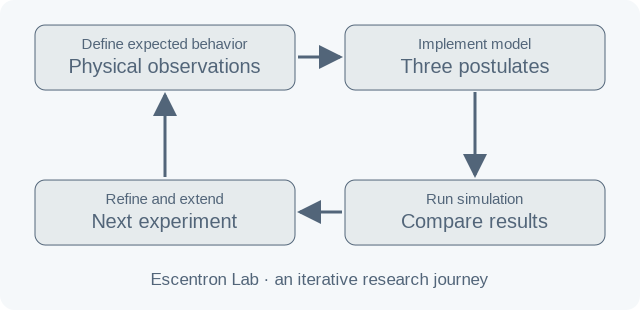
A digital laboratory
An important part of this project is the development of a digital laboratory called the Escentron Lab.
Here, we will develop the mathematical model, build simulation tools, design experiments, and study the results.
The same fundamental principles will be tested under many different conditions.
Every successful experiment brings us closer to understanding how much of nature can emerge from these simple principles.
And every unexpected result gives us something new to investigate.
An open scientific journey
I want to share this entire journey with you.
Alongside the development of the theory and its simulation tools, I will document the process through a series of videos on YouTube.
You will see how the model develops, how experiments are designed, how problems are discovered, and how new ideas emerge.
This website will be the scientific home of that journey. Here, you will find the fundamental principles, mathematical definitions, experiments, simulations, and research results as the project grows.
The ultimate goal is to create a simple mathematical language through which we can reproduce and understand the complexity of nature.
Let's begin with one particle.
Nima Amin