
Mathematical Framework / Research in development
Fields
Based on The Three Escentron Postulates — Version 2.0, Revision alpha.7.
Two independent fields
Each Escentron generates two radial fields: a gravitational field associated with its gravitational mass and a levitational field associated with its pulse.
The gravitational field points toward the source. The levitational field points away from the source.
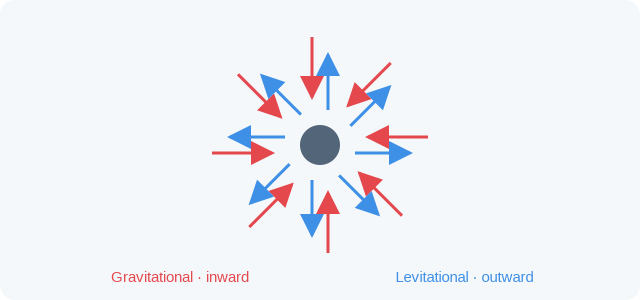
Gravitational field
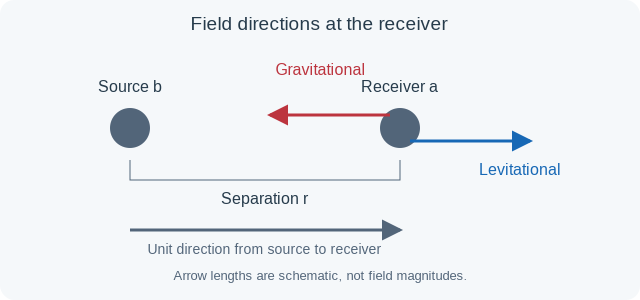
Let denote the source Escentron and the receiving Escentron. Let be their separation and the unit vector pointing from toward .
The gravitational field generated by at is
The positive coefficient is constant. The negative sign indicates that the field points toward the source. Its magnitude is proportional to the gravitational mass of the source and decreases with the square of the distance.
Levitational field
The levitational field generated by the same source at the receiver is
The positive coefficient is constant. The positive sign indicates that the field points away from the source. Its magnitude is proportional to the pulse of the source and decreases with the cube of the distance.
Field magnitude and distance
The two fields follow different distance laws:
At fixed source properties, doubling the distance reduces the gravitational field magnitude to one quarter and the levitational field magnitude to one eighth.
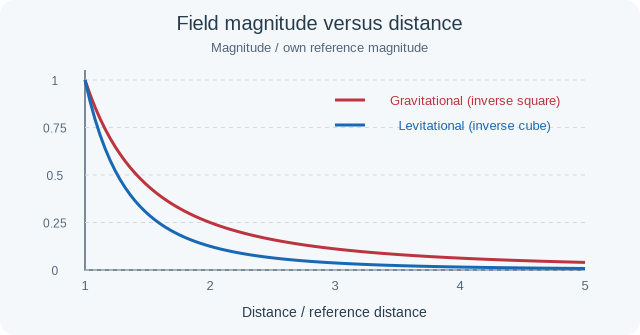
Each field magnitude is normalized to its own value at the same reference distance.
Both expressions are defined at nonzero separation. A zero-separation interaction requires a separately specified treatment.
Abstract work of a single Escentron
The two fields remain independent. Their effects, however, can be combined as work.
Consider a single Escentron with gravitational mass and pulse . To study its field structure in an abstract way, we evaluate the unrestricted work that its fields would induce on a unit gravitational mass and a unit pulse at distance .
There is no second physical particle in this analysis. The unit response is a mathematical probe. The presence of a field alone does not imply that work or energy conversion is actually taking place.
The two abstract work vectors are
The unit response factors are implicit in these expressions. Since the vectors point in opposite directions, their vector sum is equivalent to a difference of magnitudes:
Abstract balance and maximum attraction
Following the Balance Relation, let denote the abstract balance parameter of the source. For the unit response, the dimensional work-balance distance is denoted by :
Here the expression for the dimensional distance uses the chosen unit response convention; the unit mass and pulse factors are implicit.
Let be the signed inward component of the abstract work vector. Positive values indicate attraction and negative values indicate repulsion.
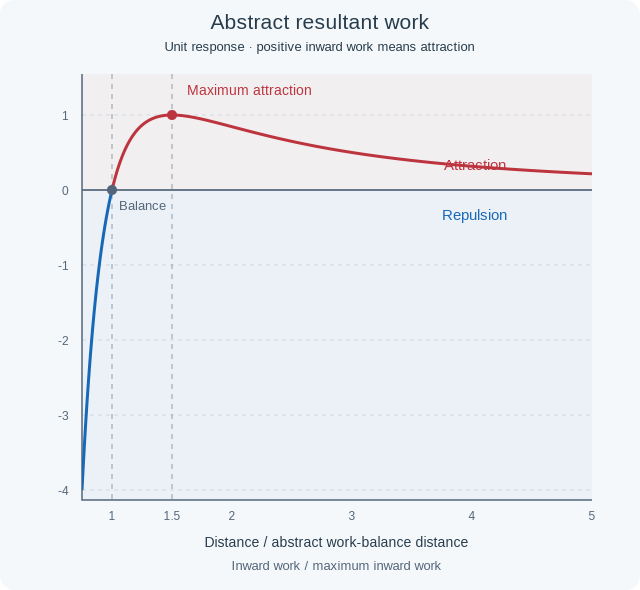
At the balance distance, the two work effects cancel. At shorter distances, the levitational effect dominates. At greater distances, the gravitational effect dominates and gradually tends to zero as distance increases.
Differentiating the inward component gives
The derivative changes from positive to negative at
This is the distance of maximum abstract attraction. In normalized coordinates where the balance distance equals , the zero occurs at and maximum attraction occurs at .
This curve describes the abstract response to the fields of one Escentron. An actual interaction also depends on the receiving particle's gravitational mass and pulse and the numerical work limit.
Superposition of fields
When several Escentrons surround a receiving particle, the contributions of each field kind add independently.
The gravitational contributions form one vector sum, and the levitational contributions form a separate vector sum.
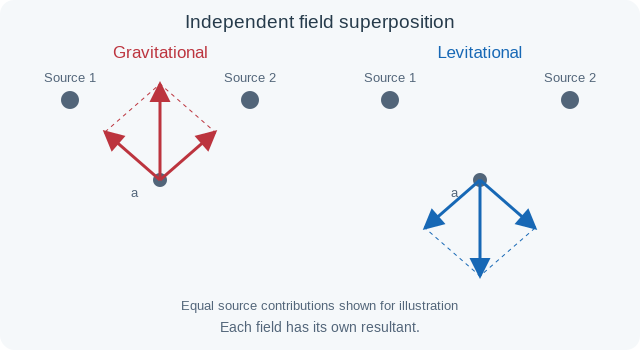
The two total fields remain distinct. The model combines their effects at the level of work, rather than combining the fields themselves.
From fields to work
Each total incident field induces a work vector according to the receiving particle's own gravitational mass or pulse. The unrestricted work vectors for a simulation step are
The source properties determine the generated fields; the receiver properties determine its response. The existing common numerical work limiter is applied before the work vectors are combined.
References: The Three Escentron Postulates, Work, Balance Relation.