
Mathematical Framework / Research in development
Conservation
Based on The Three Escentron Postulates — Version 2.0, Revision alpha.7.
Conservation within each Escentron
Each Escentron carries its own constant cosmic energy.
The distribution of this energy changes during an interaction. The total remains constant for each individual particle.
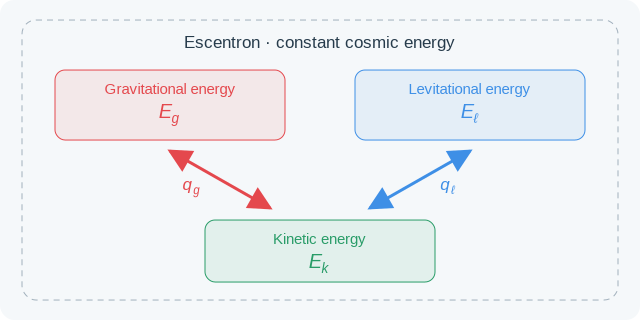
Energy conversion
The resultant kinetic work changes the kinetic vector:
Its change in magnitude determines the scalar change in kinetic energy:
For nonzero resultant work, the allocation rule assigns shares to the two energy conversion channels:
The signed transfers are
Therefore,
If the resultant work is zero, both transfers and the kinetic energy change are zero, so the same identity holds.
Proof of conservation
After a simulation step, the three reservoirs contain
Adding the three updated energies gives
Hence,
The energy lost by one or both nonkinetic reservoirs is exactly the energy gained by the kinetic reservoir, and vice versa.
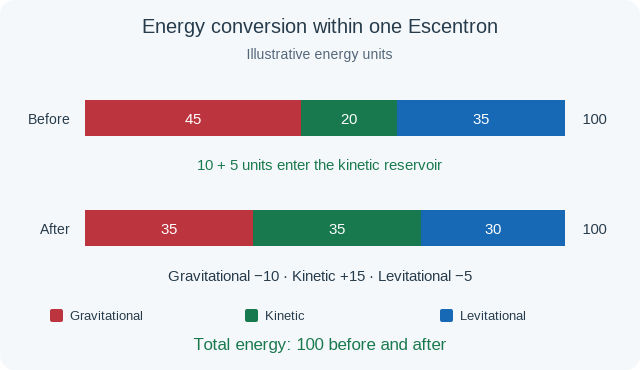
The figure uses arbitrary energy units and illustrates a transfer of 10 units from the gravitational reservoir and 5 units from the levitational reservoir to the kinetic reservoir. It illustrates the bookkeeping identity, not a measured interaction or simulation result.
Conservation in a system of Escentrons
For a fixed collection of interacting Escentrons, each particle independently satisfies the conservation identity. Using as the particle index,
Summing over the same collection gives
The model describes interactions through fields and internal energy conversion. Each Escentron preserves its own cosmic energy.
Numerical conservation
The common work limiter protects the positive gravitational and levitational reservoir floors. When work is limited, the kinetic energy change and both signed transfers are recomputed from the accepted work vectors.
The conservation identity therefore holds for the accepted step as well. In a finite-precision implementation, small rounding errors may remain. Simulation tests must check energy conservation within a documented numerical tolerance.
The proof establishes internal algebraic conservation under the model's update rules. It does not by itself establish agreement with experimental physics or conservation of other physical quantities.