
Mathematical Framework / Research in development
Work
Based on The Three Escentron Postulates — Version 2.0, Revision alpha.7.
Work induced by a field
The gravitational field drives energy conversion between the gravitational and kinetic reservoirs of an Escentron. The levitational field drives energy conversion between its levitational and kinetic reservoirs.
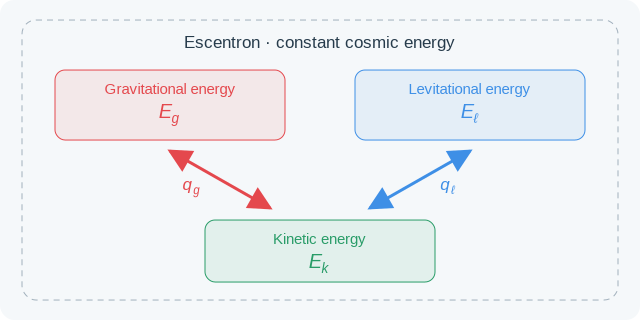
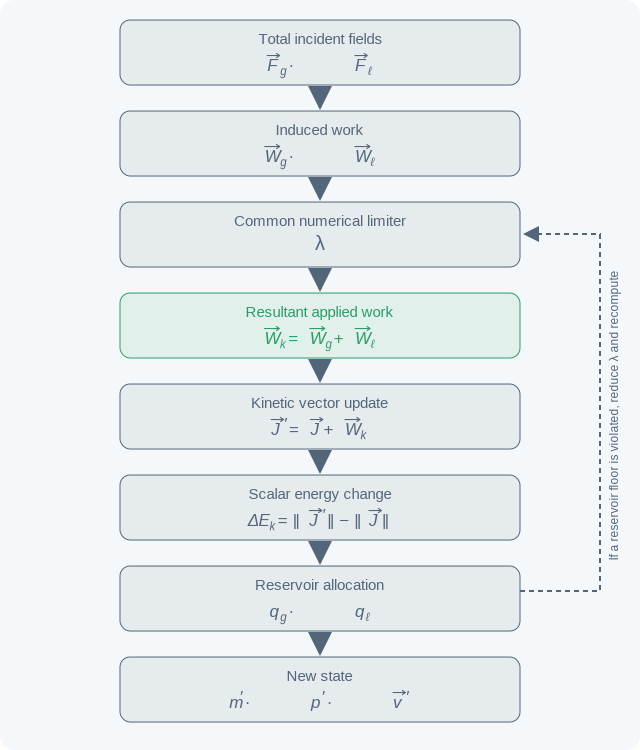
Each field induces a work vector along its own direction. The unrestricted work vectors for one simulation step are
Here and are the receiving particle's gravitational mass and pulse, and and are its total incident fields. The positive coefficients and are fixed for a given step duration. If that duration changes, the coefficients scale proportionally.
The common numerical limiter is applied to both unrestricted vectors before their resultant is used. In the equations below, the work vectors denote the resulting applied values.
The golden relation of work
The kinetic work vector is the vector sum of the gravitational and levitational work vectors.
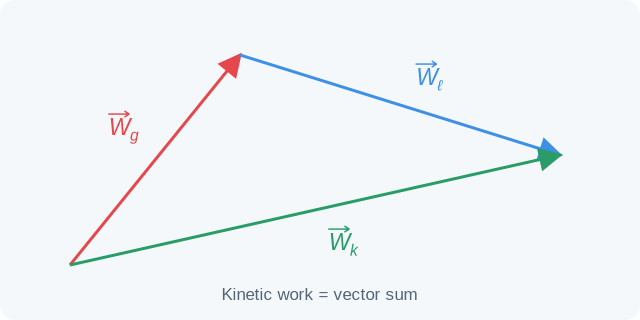
The kinetic vector has the direction of the particle's velocity and the magnitude of its kinetic energy.
Kinetic work is the change in this vector:
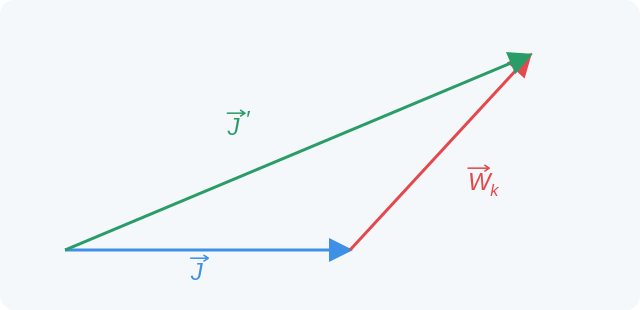
The scalar change in kinetic energy is the difference between the magnitudes of the new and previous kinetic vectors.
A positive change increases kinetic energy, and a negative change decreases it. A change in the kinetic vector can also change the direction of motion without changing its magnitude.
Allocation between energy reservoirs
When , the gravitational share is determined by the scalar projection of gravitational work onto the resultant, normalized by the resultant magnitude and restricted to the interval .
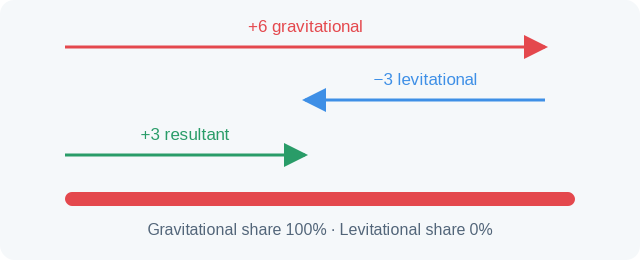
Opposing work contributions cancel before energy is allocated. For example, take collinear gravitational and levitational work vectors with signed components and . The resultant component is , giving gravitational and levitational shares of and , respectively.
The signed scalar energy transfers are
The gravitational and levitational reservoirs are updated according to
Positive transfers deplete the corresponding reservoirs; negative transfers replenish them. If the resultant work vector is zero, both transfers are zero. Since , these updates conserve cosmic energy.
Numerical work limit
Each gravitational and levitational energy reservoir must remain at or above the positive numerical floor .
Start with the common factor . If a proposed energy transfer would violate either floor, reduce , apply it to both unrestricted work vectors, and recompute the resultant, kinetic energy change and reservoir transfers. For positive , this common scaling preserves the direction of the resultant and its allocation shares.
At the floor, a reservoir retains a nonzero unrestricted response to a nonzero incident field and can receive energy.
Recovering the next state
Recover gravitational mass, pulse, and velocity from the updated energies:
For the complete source specification, see the third postulate. For symbol definitions, see Definitions and Notation.