
Mathematical Framework / Research in development
Dynamics
Based on The Three Escentron Postulates — Version 2.0, Revision alpha.7.
The state of an Escentron
The dynamical state of an Escentron is described by three variable properties: gravitational mass, pulse, and velocity.
These properties determine the distribution of its cosmic energy.
The position of the particle determines where it generates its fields and where it receives the fields of other particles.
During each simulation step, the incident fields drive a change in the particle's state.
From fields to motion
Each Escentron receives two independent total fields. These fields induce gravitational and levitational work according to the current properties of the receiving particle.
These are the unrestricted work vectors. After applying the common numerical work limiter, the two applied work vectors combine into kinetic work.
The kinetic work vector changes the kinetic vector of the particle.
This change can affect both the speed and the direction of motion.
Changes in motion
The magnitude of the kinetic vector represents kinetic energy, while its direction represents the direction of motion.
Three illustrative cases help us understand how kinetic work changes motion.
Acceleration (increasing speed)
Kinetic energy increases when the updated kinetic vector has a greater magnitude.
Deceleration (decreasing speed)
Kinetic energy decreases when the updated kinetic vector has a smaller magnitude.
Change of direction at constant speed
The direction of motion can change while kinetic energy remains constant.
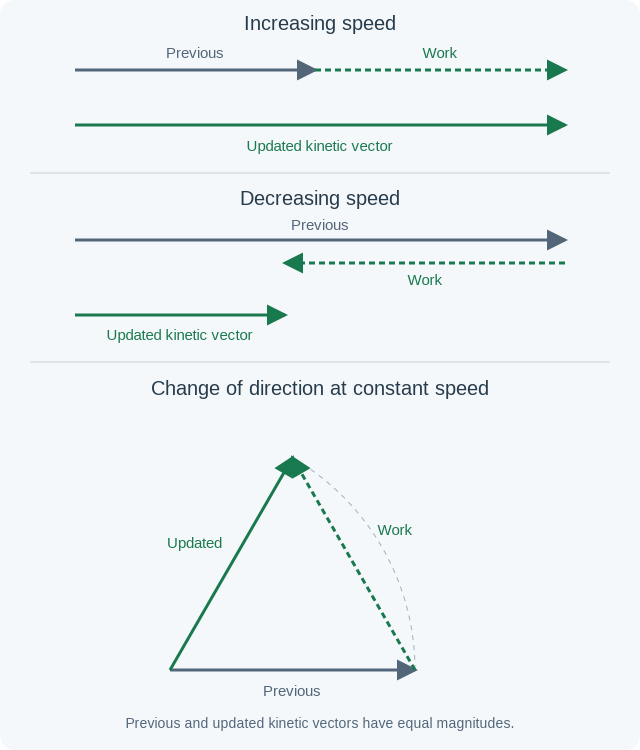
These are geometrical examples of the kinetic vector update, not simulated trajectories.
Recovering the next state
Once the kinetic vector has been updated and energy has been allocated between the reservoirs, the next state of the particle can be recovered.
The particle's new velocity determines its updated direction and speed. Its new gravitational mass and pulse determine the fields it generates in its updated state.
The dynamical cycle
The updated state becomes the basis for the next simulation step. Through repeated application of the same relations, the model describes the evolution of interacting Escentrons.
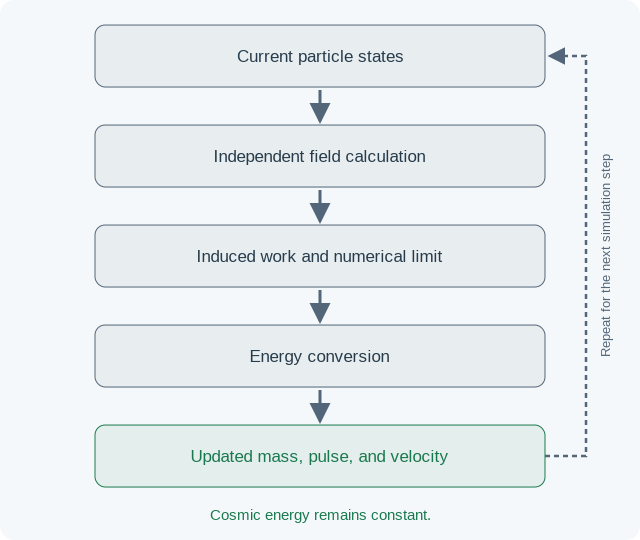
Throughout this process, the cosmic energy of each Escentron remains constant.
The spatial integration rule and the treatment of simulation time require a numerical convention consistent with these state-update equations. The current postulates do not specify a position-integration algorithm.
References: The Three Escentron Postulates, Energy, Fields, Work.