
Mathematical Framework / Research in development
Mathematical Framework
Based on The Three Escentron Postulates — Version 2.0, Revision alpha.7.
The mathematical framework of the Simplification Theory begins with a single particle, the Escentron, and three postulates. Together, they describe how the particle stores energy, generates fields, and responds to the fields of other particles.
Three postulates, one framework
I. Cosmic energy. Each Escentron carries a constant amount of cosmic energy, distributed among three forms:
Gravitational energy is associated with gravitational mass, kinetic energy with velocity, and levitational energy with pulse.
II. Fields. Each Escentron generates two independent radial fields. The gravitational field points inward and follows an inverse-square distance law. The levitational field points outward and follows an inverse-cube distance law.
III. Work. Incident fields induce two work vectors. After the common numerical limiter is applied, their effects combine into kinetic work:
The resultant work changes the kinetic vector. Energy is redistributed within the particle, and its gravitational mass, pulse, and velocity are updated.
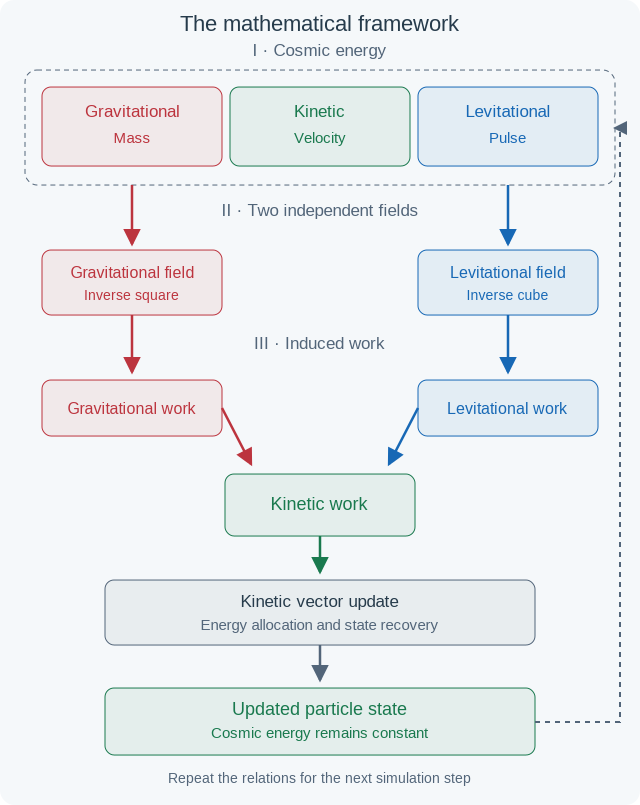
The same relations describe each successive state of the model.
Explore the framework
| Chapter | What it describes |
|---|---|
| Definitions and Notation | The common mathematical language and meaning of each symbol. |
| Energy | The three energy reservoirs and their quadratic relations to particle properties. |
| Fields | Field generation, distance laws, independent superposition and abstract work effects. |
| Balance Relation | Abstract and interactive balance, and the distance at which opposing work effects cancel. |
| Work | Field-induced work, the golden relation, energy allocation and numerical limits. |
| Dynamics | How the kinetic vector and the particle's properties change from one state to the next. |
| Conservation | The algebraic proof of cosmic-energy conservation for each Escentron. |
From mathematics to experiments
This framework provides the mathematical basis for implementing the Escentron model and designing simulation experiments. Each experiment can compare the behavior produced by these relations with an expected physical behavior.
The next research objective is to determine whether the same mathematical framework can reproduce increasingly complex physical phenomena. The current specification defines an experimental model. Physical units, spatial integration and time-stepping behavior remain subject to validation.